
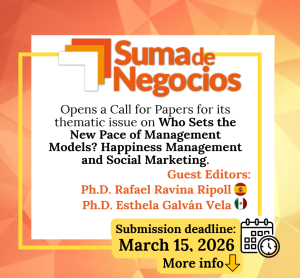
Call: Who Sets the New Pace of Management Models? Happiness Management and Social Marketing
Important Dates
Manuscript Submission Deadline: 15 March 2026
Publication of the Special Issue: Q4 2026 / Q1 2027
Description
This special issue is intended to provide relevant academic evidence on the importance of happiness management and social marketing in strengthening management models that—without internal barriers—stimulate creativity, intrapreneurship, innovation, and disruptive thinking of human capital in the era of Industry 5.0. From this perspective, the purpose of this special issue is, on the one hand, to place on the academic table the need for corporate governance to orient its organizational culture toward the creation of dynamic, agile, and collaborative environments that foster workplace happiness and employee commitment. And on the other hand, to highlight that corporate leaders must consider that happy employees have great relevance in the economic success of companies.
The objectives of this special issue are to demonstrate that:
- Happiness management constitutes an organizational philosophy that proactively stimulates teamwork, ethical values, innovation, interpersonal relationships, etc.
- Corporate governance must develop leadership styles oriented toward promoting a business culture that heralds workplace well-being, prosperity, social responsibility, and sustainability.
- Happiness management and social marketing constitute the bases for cultivating management models aimed at developing dynamic, flexible, and healthy environments.
- Social marketing is an extremely useful and effective tool for companies to serve as agents of change toward a more inclusive, happier, and more supportive society.
- Happiness management designs management models that allow achieving holistic balance between business profits and the collective happiness of a company’s human capital.
The topics to be discussed in this special issue include, but are not limited to, the following:
- Social marketing and happiness management in a globalized society
- Corporate governance and workplace happiness
- Innovation management and happiness management
- Artificial intelligence and social marketing
- Emotions and corporate well-being
- Strategic management and business happiness
- Leadership styles and happiness management
- Social marketing and organizational culture
- Business economics and happiness management
The papers submitted to this special issue will provide scientific knowledge and practical applications aligned with the Sustainable Development Goals (SDGs), especially SDG 3 (Good Health and Well-Being), SDG 8 (Decent Work and Economic Growth), and SDG 9 (Industry, Innovation, and Infrastructure).
This special issue is aimed primarily at researchers and professionals studying happiness management and social marketing, with the aim of demonstrating that corporate management models must pivot around the happiness, creativity, and innovation of human capital. Purely theoretical articles (e.g., systematic literature reviews, qualitative meta-analytical reviews) are welcome, as well as empirical articles that contribute to theory using any methodological approach (e.g., time-lagged studies, longitudinal studies, surveys, cross-national comparative studies, case studies).
Submission Guidelines
Submissions must fully comply with the guidelines for authors available at https://revistasumadenegocios.konradlorenz.edu.co/en/authors-guidelines-publication-norms/ , use the templates at https://revistasumadenegocios.konradlorenz.edu.co/en/article-submission-and-review/ , and upload the documents on the platform https://mc04.manuscriptcentral.com/sumneg
Guest Editor Details

Ph.D. Rafael Ravina Ripoll
- Associate Professor of Business Organization, University of Cádiz (Spain)
- Director of the International University Network of Happiness (https://felicidad-indess.uca.es/)
- ORCID: https://orcid.org/0000-0001-7007-3123

Ph.D. Esthela Galván Vela
- Professor and Researcher in Accounting and Management, CETYS University (Mexico)
- ORCID: https://orcid.org/0000-0002-8778-3989
Contact
Any inquiries can be sent to: sumadnegocios@konradlorenz.edu.co
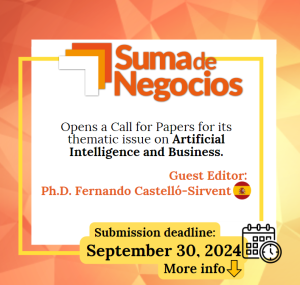
Call: Artificial Intelligence and Business
Important Dates
Manuscript Submission Deadline:September 30, 2024
Issue Publication: 2025
Description
This issue of Suma de Negocios encompasses the study of new perspectives on the impact of Artificial Intelligence (AI) on business strategy, economic and competitive analysis, decision-making, organization and personnel management, crisis management, and the incorporation of Large Language Models (LLM) in work routines.
The purpose of this issue is to contribute to the academic debate at the intersection of AI and business management, providing knowledge and practical managerial recommendations as well as advice on public policy design.
This issue welcomes theoretical studies, empirical research, systematic literature reviews, and bibliometric analyses.
The objectives of this issue are:
- To analyze the transformative effects of AI on decision-making and organizational structures.
- To examine the role of AI in problem-solving and the development of competitive business strategies.
- To investigate how AI integrates into business processes and contributes to shaping business strategies.
- To explore the implications of AI in crisis management.
- To evaluate various methodologies in AI research and their application in business contexts.
The issue covers a wide range of topics, including but not limited to:
- The role of AI in improving operational efficiency and productivity.
- Strategic implications of AI adoption for business models and market positioning.
- Best practices for AI integration and implementation within organizations.
- AI for decision support.
- AI and the knowledge economy.
- AI in creative industries.
- The influence of AI on innovation, creativity, and entrepreneurship.
- Methodological approaches in AI research, including machine learning, natural language processing, and predictive analytics.
- Empirical studies and behavioral economics experiments.
The research presented in this issue can provide insights and practical applications aligned with various Sustainable Development Goals (SDGs), including SDG 8 (Decent Work and Economic Growth), SDG 9 (Industry, Innovation, and Infrastructure), and SDG 12 (Responsible Consumption and Production), among others.
Call for Papers
This call is directed to a diverse audience, including:
- Academics and researchers in business administration, AI, and technology fields.
- Professionals and business executives looking to leverage AI for strategic advantages.
- Policy makers and regulatory bodies interested in AI technology governance.
- Consultants and advisors working on AI implementation and digital transformation projects.
Submission Guidelines
Submissions must fully comply with the guidelines for authors available at https://revistasumadenegocios.konradlorenz.edu.co/en/authors-guidelines-publication-norms/ , use the templates at https://revistasumadenegocios.konradlorenz.edu.co/en/article-submission-and-review/ , and upload the documents on the platform https://mc04.manuscriptcentral.com/sumneg
Guest Editor Details

Dr. Fernando Castelló-Sirvent
- Professor and researcher at the Universitat Politècnica de València (UPV), Spain.
- Co-Chair of the International Congress on Artificial Intelligence, Innovation, Economics, and Business (CIECEM) (https://ciecem.org/)
- ORCID: https://orcid.org/0000-0002-2088-0039
Contact
Any inquiries can be sent to: sumadnegocios@konradlorenz.edu.co